
On this page
Termites are one of the few pests that damage the structure of a home itself. The ones that cause trouble in buildings usually live in the soil and travel into walls, door frames and woodwork through narrow mud tunnels, out of sight. Many homeowners only find them once the damage shows.
Termites do leave clues, though. Knowing which ones to look for, and which to leave alone for the technician, makes treatment simpler.
Why homes and villas are at risk
Termites need contact with soil, moisture and cellulose, the material in wood, paper and cardboard. Many homes in the Kingdom offer all three:
- Gardens and planters irrigated right up to the walls
- AC drain lines and leaking pipes that keep the ground damp beside the foundations
- Timber door frames, skirting, kitchen cabinets and fitted wardrobes on the ground floor
- Gypsum board partitions and false ceilings, whose paper facing termites can feed on
- Cardboard boxes and old furniture stored directly on the floor
- Leftover construction timber, such as formwork offcuts, buried in the soil
None of these means you have termites, but they tell you where to look first.
Early warning signs
Mud tubes
The clearest sign is a mud tube: a thin tunnel of soil, roughly the width of a pencil, running up a wall, a foundation or the side of a cabinet. These tubes shelter termites as they travel between the soil and their food. Check where walls meet the ground, around pipe entries, behind kitchen units and in storage rooms.
Hollow or damaged timber
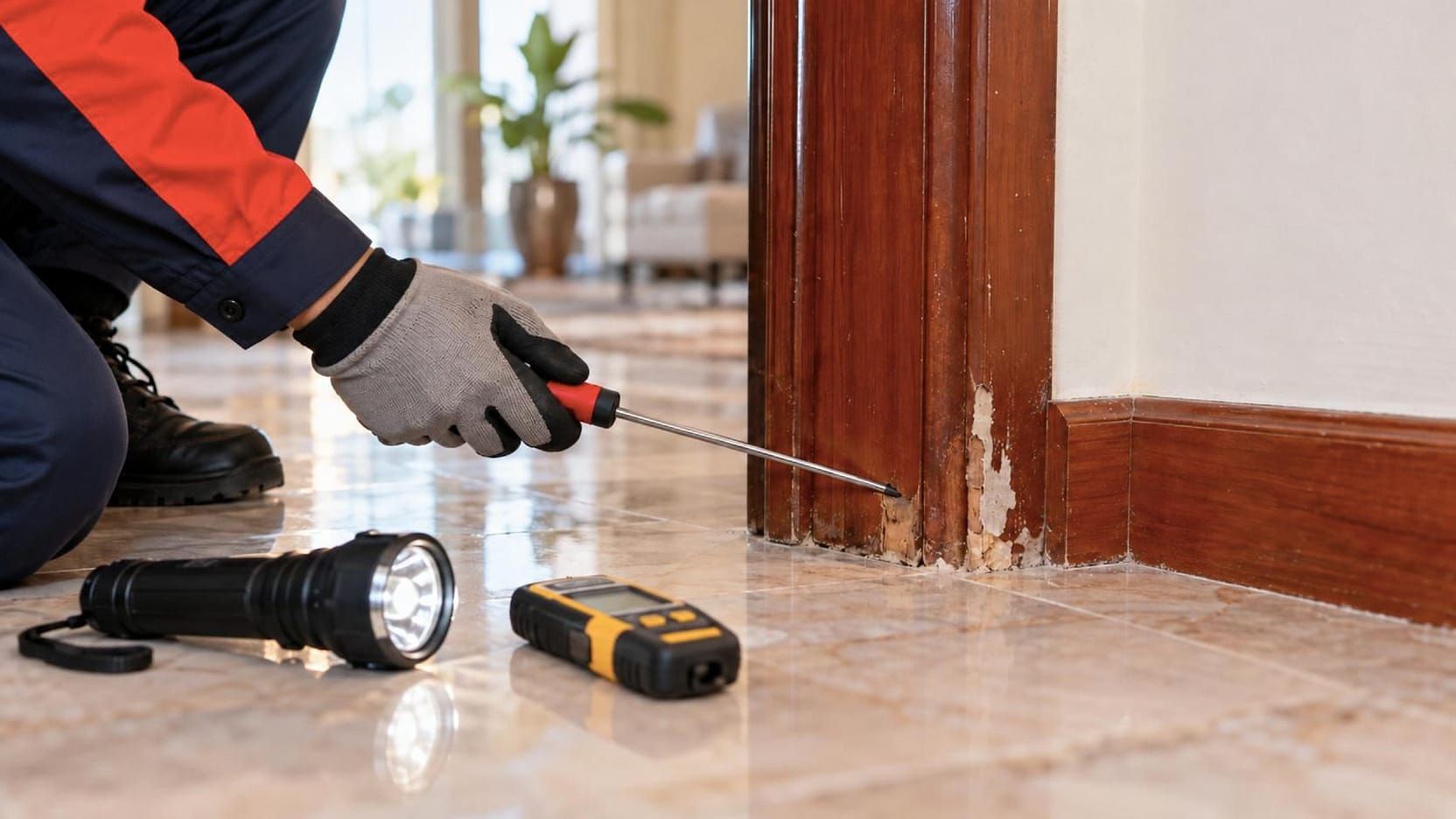
Termites eat wood from the inside and leave a thin outer layer, so the surface can look intact. Watch for:
- Door frames and skirting that sound hollow when tapped
- Paint that bubbles or blisters on timber surfaces
- Soft spots in woodwork, or soil packed into cracks and joints
- Doors and windows that suddenly start to stick
Winged termites and discarded wings
At certain times of year, mature colonies release winged termites to start new ones. Finding them indoors, or small piles of shed wings on window sills or under lights, is a strong sign of a colony nearby.
They are often mistaken for flying ants, but termites have straight antennae, a thick waist and four wings of equal length. Flying ants have bent antennae, a narrow waist and longer front wings.
A simple check you can do yourself
Make this walk-round part of routine home maintenance, and repeat it after building work or whenever you notice damp:
- Walk around the outside, checking the base of every wall, the boundary wall and garden edges for mud tubes.
- Check where pipes, AC drain lines and cables enter the building, and any spot where the soil stays wet.
- Inside, check ground-floor door frames, skirting, kitchen cabinet bases and wardrobes on outside walls.
- Gently tap timber with the handle of a screwdriver and listen for a hollow sound. Do not dig into it.
- Lift boxes and papers in storerooms; soil on the underside or chewed bottom edges can mean termites are coming up from the floor.
- Photograph anything unusual and note where it was; this helps the technician.
What not to do before the survey
Some natural first reactions make the problem harder to solve.
- Do not spray insecticide on mud tubes or visible termites. You will only reach the few workers in sight, while the colony stays in the soil and may shift its activity somewhere harder to find.
- Do not break open or scrape away mud tubes. Active tubes show the technician where termites are entering and whether the activity is current.
- Do not remove, replace or paint over damaged timber. New wood over an active colony becomes its next meal, and filler or paint hides the evidence.
- Do not drill into floors or walls, or pour products into the soil. Untrained use of pesticides puts your family and pets at risk, and products can end up in gardens, play areas or the ground around water tanks.
Leave everything as it is and keep children and pets away until the inspection.
Pre-construction and post-construction treatment
Before you build
Pre-construction treatment is applied to the soil after excavation and levelling, before the foundation slab is poured, creating a treated zone between the building and termite colonies. Where suitable, physical barriers such as stainless-steel mesh can also block entry points.
If you are building a villa or an extension, ask your contractor early how termite protection fits the programme: the soil must be treated at the right stage and left undisturbed until the slab is poured.
Existing buildings
In a finished building, treatment targets the walls, floors and entry points where activity is found, using the method the survey points to. Expect advice too: fixing leaks, moving irrigation away from walls and lifting timber off the floor all make a home less attractive to termites.
Buying or renting a villa? An inspection before you move in shows you its condition.
When to call a professional
Book an inspection if:
- You have found mud tubes, hollow timber or winged termites indoors
- Neighbours have had termites, since colonies forage through the soil regardless of boundary walls
- You are planning a new build, an extension or major landscaping
- Your home was treated before and you are seeing new signs
A survey checks the soil, walls, timber and service entries, maps activity and risk areas, and ends with a written recommendation for treatment and follow-up.
If you have noticed any of these signs, or you are preparing to build, book a site survey with Eastern Alliance: call 92 000 6148 or message us on WhatsApp.