
Eastern Alliance — Home
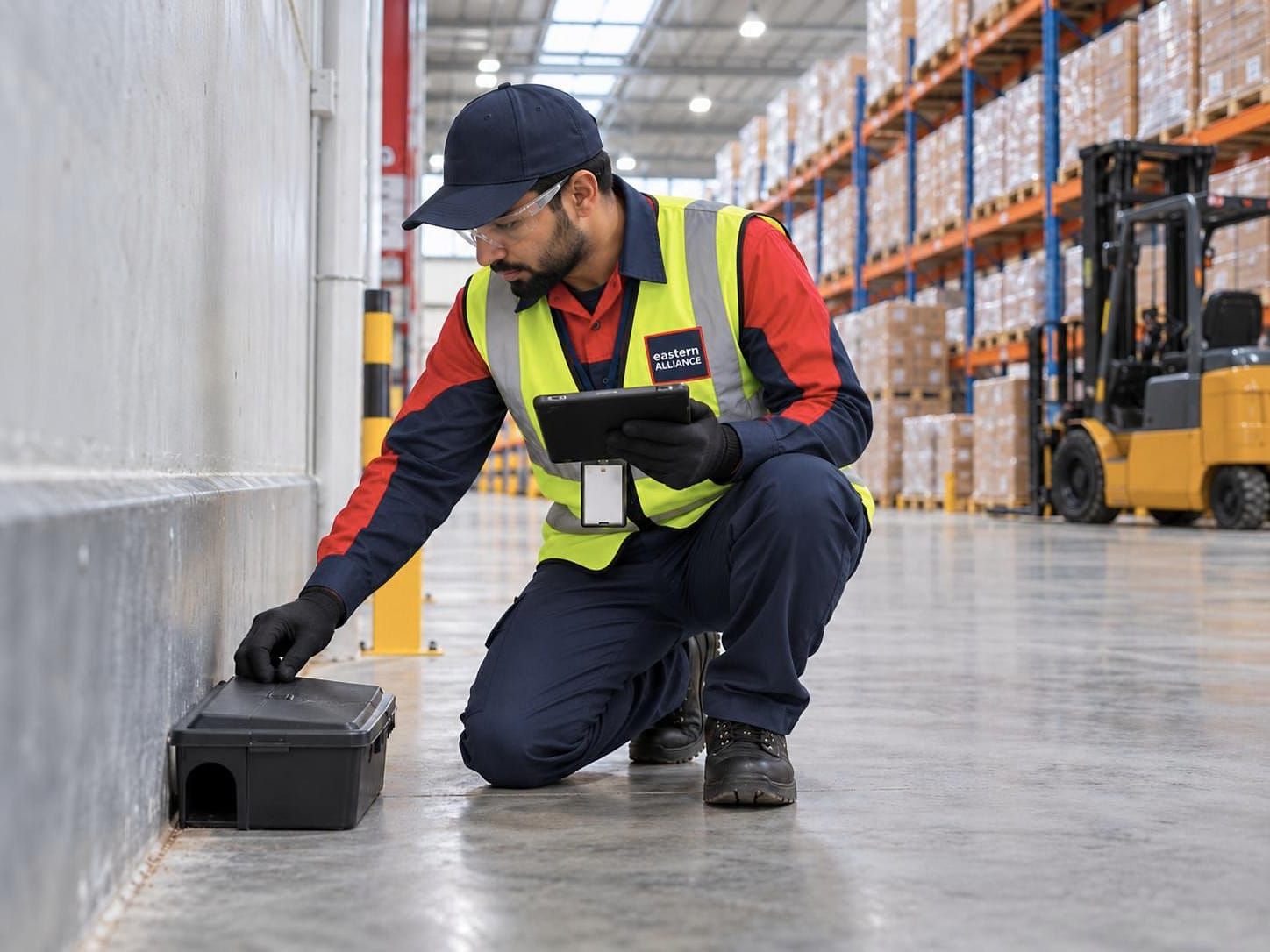
Eastern Alliance technician servicing a monitoring station during a scheduled visit to a commercial site

Commercial pest control · Offices, retail, hospitality & healthcare

Commercial pest control

Keep your premises inspection-ready, without closing the doors.

A single sighting in a dining room, ward or shop floor costs more than the treatment. We run scheduled programmes for offices, malls, hotels, restaurants, hospitals, schools and government buildings: surveyed first, treated discreetly outside your busiest hours, and documented after every visit so your records are ready when the inspector arrives.

  • Scheduled visits & bait-station maps
  • Reports for Balady & SFDA inspections
  • Treatment outside working hours

Service areas:Al KhobarDammamRiyadhJeddahJubailJizanTabukall of Saudi Arabia

When to call us

Signs your premises need a structured programme

In a busy building the first sign is usually a complaint from a guest, a note in an audit or a sighting by the night cleaners. These are the reasons facility managers and HSE officers most often call us:

  • Cockroaches or flies in kitchens, dining areas, pantries or staff rooms
  • Droppings, gnaw marks or torn packaging in stores, false ceilings or service risers
  • A municipality, SFDA or internal audit coming up and no visit records to show
  • Complaints from customers, patients, pupils or tenants
  • A new branch, outlet or fit-out about to open
  • Activity that returns a few weeks after each one-off treatment

Scope

Premises we cover

  • Offices, towers and business parks
  • Shopping malls, supermarkets and retail stores
  • Hotels, furnished apartments and resorts
  • Restaurants, cafés, central kitchens and catering units
  • Hospitals, clinics, laboratories and pharmacies
  • Schools, universities and training centres
  • Government buildings, ministries and public facilities
  • Banks, showrooms and event venues

Why act now

Why a pest problem in a commercial building cannot wait

  1. Inspections and licences

    Municipality (Balady) inspectors and the SFDA check food premises for pest activity and for pest-control records. A finding can mean a warning, a fine or a closure notice, and the first thing the inspector asks for is the record of what you did about it.

  2. Reputation travels fast

    One cockroach in a restaurant, hotel room or clinic ends up in a review, a photo or a complaint to head office. For a brand with several outlets, one branch's problem becomes everyone's.

  3. Health of staff and visitors

    Cockroaches and flies carry bacteria from drains and bins onto food-contact surfaces; rodent droppings and urine contaminate stores. In hospitals, schools and kitchens the people exposed are the ones least able to afford it.

  4. Small problems become building-wide

    Shared risers, false ceilings, waste rooms and ducts connect every tenant and floor. A problem that starts in one food court unit or plant room spreads through the building if it is not found and treated early.

Options

Programme options

A scheduled contract suits most premises; the other options cover the moments in between.

  • Scheduled contract

    Regular visits at the frequency the survey sets, with numbered bait stations and insect monitors, treatment wherever activity shows, a report after every visit and a review of the year's trend.
  • Food-safety programme

    For restaurants, central kitchens, hotels and food retail: methods matched to food-handling areas, insect light traps and gel baits rather than open spraying, and records laid out to support your HACCP-based plan and inspections.

  • One-off treatment

    A survey and targeted treatment for a specific problem: activity found in an audit, a unit changing tenant, or a new outlet before opening day.

  • Multi-site accounts

    For chains, banks and property managers with branches in several cities: one contact, one reporting format and one programme, delivered from our offices in Al Khobar, Jeddah, Riyadh, Jubail and Tabuk.

Method

How a commercial programme works

Every programme follows the same four steps. Visit frequency, monitoring points and the methods allowed in each area are set by the survey and by the rules your premises work to.

  1. 01

    Site survey

    We walk the premises with your facility or hygiene lead, inspect kitchens, stores, waste rooms, drains, false ceilings and loading areas, and map activity, entry points and the conditions that feed it.

  2. 02

    Programme plan

    You receive a written scope: target pests, visit frequency, the methods approved for each area and a site map numbering every bait station and trap, ready to file with your food-safety or facility records.

  3. 03

    Discreet scheduled treatment

    Trained technicians service the stations, treat where activity is found and proof entry points at the agreed times, before opening, after closing or at night, so guests, patients and staff notice nothing.

  4. 04

    Reports & trend review

    Every visit ends with a written report: what was checked, what was found, products used and recommendations for your team. Station counts are tracked visit to visit so you can see activity falling, backed by our service warranty.

Why Eastern Alliance

Why facility teams choose Eastern Alliance

  • ISO 9001, 14001 & 45001Certified quality, environmental and occupational health and safety management systems, the paperwork your procurement and HSE teams ask for.
  • Audit-ready recordsA written report after every visit, with treatment records, product names and recommendations, plus the station map. Facility teams use them for Balady, SFDA and internal audits.
  • Trained in-houseTechnicians trained at our own training centre, open since 2012, on methods, safety, PPE and how to work in occupied buildings.
  • Approved, low-impact productsPesticides used under Saudi regulations, from ranges approved by the WHO, the SFDA and the US EPA, applied by trained technicians to protect staff, customers and the environment.

Safety in an occupied building

Treatments are limited to the areas that need them and timed around opening hours, services and meal times. Food, utensils, stock and sensitive equipment are covered or moved beforehand, as set out in the plan. Your technician states which areas to keep clear and for how long, records the products used on the visit report, and places tamper-resistant bait stations out of public reach.

Prevention

How to keep pests out between visits

Most activity in commercial buildings traces back to food, water and a way in. Your team controls all three.

  • Close the waste loopKeep bin lids closed, empty internal bins before closing and keep the waste room washed and away from kitchen doors; flies and cockroaches breed where waste sits.
  • Clean the places nobody seesGrease under cooking lines, behind fridges and inside floor drains feeds cockroaches for weeks. Put these spots on the deep-cleaning rota.
  • Fit door seals and fly screensBrush strips under external doors, self-closers on service entrances and screens on openable windows stop rodents and flies walking in with deliveries.
  • Check deliveries and storageInspect incoming cartons for droppings, gnaw holes and live insects, keep stock off the floor and away from walls, and rotate it so nothing sits for months.
  • Fix leaks and standing waterDripping taps, AC drain lines and blocked floor drains give cockroaches, flies and mosquitoes the water they need. Report and repair them quickly.
  • Act on the visit reportEach report lists what we found and what needs fixing on your side: a gap under a door, a cracked drain cover, a store that needs clearing. Closing those items is what keeps the counts falling.

Price and quote

What decides the price of a commercial programme

There is no rate card: the quote follows the survey, is itemised visit by visit and reflects the size of the premises, the risk level of each area and the frequency your inspections call for.

  • Size and layout of the premisesFloor area, number of kitchens, stores and floors, and how many stations they need.
  • Type of activityFood handling, healthcare and hospitality need more frequent visits than offices.
  • Current level of activityEstablished infestations need an intensive start before the routine schedule begins.
  • Access and timingNight or weekend work, multiple sites and special access or permit requirements.

Inspection first, then an itemised quote with every visit listed and no hidden extras.

Request a quote

Tell us what you are seeing and where. A coordinator will call you back to arrange a survey.

Saudi mobile or landline, e.g. 05X XXX XXXX

Preferred contact method

FAQ

Frequently asked questions

How often will you visit our premises?
The survey decides it. Offices often run on a monthly or bi-monthly schedule, while restaurants, central kitchens, hotels and hospitals usually need more frequent visits because of food, moisture and footfall. The agreed frequency is written into your programme and can be reviewed as the counts fall.
Will the reports satisfy a Balady or SFDA inspection?
Our reports give inspectors what they normally ask for: a record of each visit, the areas checked, findings, products used, a numbered station map and recommendations. They support your own food-safety plan and audits; the inspection outcome also depends on the hygiene and maintenance items your team controls.
Can you treat without disturbing customers, patients or guests?
Yes. Visits are scheduled before opening, after closing, at night or during low-occupancy periods, and the methods in public areas are discreet: gel baits, enclosed stations and insect light traps rather than open spraying. Your technician agrees timings with your duty manager.
Do you work in hospitals, clinics and other sensitive environments?
Yes. In healthcare, schools and food premises we use the lowest-impact method that will work in each area, coordinate with infection-control or hygiene staff, and record every product used so your team can answer any question later.
What is a bait-station map and why does it matter?
It is a plan of your premises with every rodent station and insect monitor numbered. Each visit records what was found at each number, which is how we spot a trend, prove the stations were checked and show an auditor exactly where the control points are.
Can you cover several branches in different cities?
Yes. With our head office in Jeddah, branches in Al Khobar, Riyadh and Tabuk and a service centre in Jubail, we run one programme and one reporting format across sites throughout Saudi Arabia.
Which documents can you provide for our vendor file?
Commercial registration, ISO 9001, ISO 14001 and ISO 45001 certificates, insurance details and, where relevant, our Saudi Aramco and Royal Commission vendor registrations. The certificates are on our downloads page; the rest is available on request.
Do we have to close the kitchen or vacate the floor during treatment?
Rarely. Gel baits, station servicing and crack-and-crevice work are done with the area out of use for a short time only. Where a space treatment is needed, your technician states how long the area must stay clear and when surfaces may be used again; follow the instructions on the visit report.
How do we get started?
Call us or request a quote online. We arrange a survey of the premises with your facility or hygiene lead, then send an itemised proposal with the visit schedule, methods and reporting. There is no obligation at the survey stage.

Industrial pest control

Pest control for plants, refineries, warehouses, ports and camps, run under permit-to-work and HSE rules with documentation for audits.

View service

Annual maintenance contracts

Scheduled visits, monitoring, treatment as needed and a report after every visit, under one contract for the year.

View service

Cockroach control

German and American cockroaches in kitchens, bathrooms, drains and food premises, treated with gel baits and crack-and-crevice methods.

View service

Rodent control

Rats and mice removed, entry points sealed, and bait stations monitored on schedule.

View service

Fly control

Source reduction in waste areas and drains, fly traps and ribbons, and residual treatment for kitchens, food factories and farms.

View service

Learn more about the pest

Cockroaches

How to tell German, American and other cockroaches apart, what their droppings and egg cases look like, and what keeps a kitchen free of them.

Read the guide

Rodents

How to tell the Norway rat, roof rat and house mouse apart by size, droppings and habits, the damage they do, and how to keep them out.

Read the guide

Flies

House flies, drain flies, fruit flies, blow flies and coastal midges: where each one breeds, what it carries and why ribbons alone do not solve it.

Read the guide