
Eastern Alliance — Home
Disinfection & sanitization by Eastern Alliance

Disinfection & sanitization · Offices & facilities

Disinfection & sanitization

Fewer germs on the surfaces everyone touches.

Door handles, desks, lift buttons and washroom fittings pass bacteria and viruses from hand to hand every day. We disinfect offices, clinics, schools and other facilities to reduce germs on these surfaces, with visits timed around your working hours and a record kept of each one.

  • Offices, clinics & schools
  • High-touch surfaces
  • Out-of-hours visits

Service areas:Al KhobarDammamRiyadhJeddahJubailJizanTabukall of Saudi Arabia

When to call us

When to book disinfection

Shared surfaces carry bacteria and viruses from one person to the next. Facilities usually call us in these situations:

  • Receptions, lifts, washrooms and pantries in heavy daily use
  • An illness reported among staff, students or visitors
  • Reopening after a closure, renovation or holiday period
  • A hygiene audit or inspection coming up
  • Surfaces soiled by rodents, birds or other pests

Scope

Areas and surfaces we treat

  • Offices and meeting rooms
  • Clinics and medical centres
  • Schools and classrooms
  • Receptions, lifts and corridors
  • Washrooms, pantries and prayer rooms
  • Door handles, switches, handrails and keypads
  • Villas and apartments

Why act now

Why disinfection cannot wait

  1. Illness moves from hand to surface to hand

    One person with a cold, flu or stomach bug touches a door handle, a lift button and a tap, and the next person picks it up. In an office, school or hotel that becomes absences within days.

  2. Pest droppings carry bacteria

    Rodent and pigeon droppings and the surfaces cockroaches cross carry bacteria such as Salmonella. Sweeping or vacuuming them dry spreads the dust; the area needs disinfection once the pests are dealt with.

  3. Inspections ask for the record

    Healthcare, food and education sites are asked how shared areas are disinfected and when. A missing or informal record is a finding, even when the cleaning itself is good.

  4. Trust is hard to win back

    Staff, parents and guests notice how a reported illness or a pest problem is handled. A documented disinfection visit is the quickest way to show the building is back in order.

Options

Scheduled or one-off

Choose the cover that matches how your site is used.

  • Scheduled programme

    Regular visits for offices, schools and clinics, timed outside working hours, covering high-touch points every time and recorded for your files.
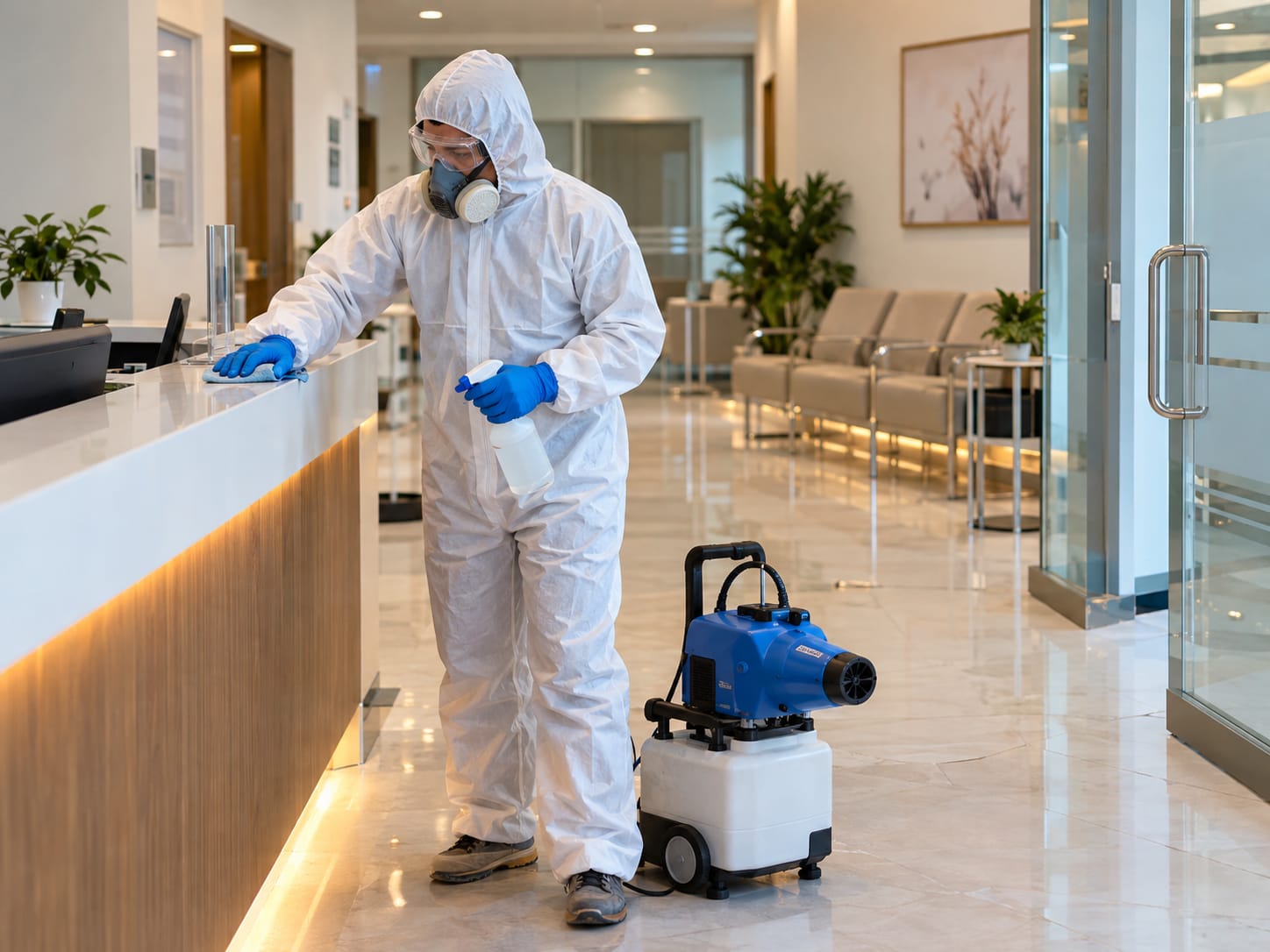
  • One-off disinfection

    A single visit before reopening, after building works, ahead of an inspection or when an illness is reported on site, with the scope agreed during the survey.

Method

How a disinfection visit works

Every visit follows the same four steps; the products and methods depend on the surfaces and how the space is used.

  1. 01

    Site survey

    We walk the site with you, map high-touch points and sensitive areas such as clinics, kitchens and server rooms, and note surfaces that need special care.

  2. 02

    Scope & schedule

    You receive a written scope listing areas, methods and frequency, with visits scheduled after hours or at weekends to keep disruption low.

  3. 03

    Disinfection

    Trained technicians in PPE apply disinfectant by spraying, fogging or wiping, and leave it on each surface for the contact time it needs to work.

  4. 04

    Handover & records

    Areas are handed back once surfaces are dry, with a record of what was treated for your facility and audit files.

Why Eastern Alliance

Why facilities choose us

  • Healthcare experience since 2001Our healthcare pest control division has served hospitals and clinics since 2001.
  • Documented visitsEvery visit recorded, ready for your facility, HSE or audit file.
  • Trained in-houseTechnicians trained at our own training centre on safe product handling and PPE.
  • Insured & guaranteedWork backed by insurance and a service warranty.

Before and after a visit

Before the visit, clear desks, put away food, documents and personal items, and cover or switch off sensitive equipment if your technician asks. Afterwards, keep people out of treated areas until surfaces are dry or the re-entry time given by your technician has passed.

Prevention

How to keep germs down between visits

Scheduled disinfection resets shared surfaces; the daily routine decides how fast they load up again.

  • Clean first, then disinfectDisinfectant does not work through grease and dust. Wipe visible dirt off, apply the product and leave it wet for the contact time on its label before drying.
  • Give high-touch points a daily listDoor handles, lift buttons, handrails, switches, keypads, taps and shared phones: a short list wiped every day beats an occasional deep clean.
  • Treat the pest before the surfaceWhere rodents, birds or cockroaches have been, disinfecting alone does not last. Deal with the pests and seal their entry points first, then disinfect the areas they used.
  • Never dry-sweep droppingsWet droppings and nesting material with disinfectant before removing them, wear gloves and a mask, and bag the waste. Dry sweeping lifts bacteria into the air.
  • Keep washrooms and pantries stockedSoap, paper towels and sanitiser at every sink, and bins emptied before they overflow: hand hygiene removes most of what disinfection would otherwise have to deal with.
  • Log what was doneA simple sheet of what was cleaned, when and by whom, kept with our visit reports, is what an auditor or inspector asks to see first.

Price and quote

What decides the price of disinfection

There is no flat rate per square metre: the quote follows the survey and covers the areas, the surfaces and the frequency your site needs, so you are not paying for rooms that do not need it.

  • Area and layoutFloor area and the number of rooms, washrooms, lifts and corridors to cover.
  • Type of siteClinics, kitchens and server rooms need specific products, methods and more preparation.
  • MethodWiping high-touch points, spraying or fogging whole rooms, or a combination.
  • Frequency and timingA one-off visit or a schedule, and work after hours or at weekends.

Inspection first, then an itemised quote with no hidden extras.

Request a quote

Tell us what you are seeing and where. A coordinator will call you back to arrange a survey.

Saudi mobile or landline, e.g. 05X XXX XXXX

Preferred contact method

FAQ

Frequently asked questions

How long does disinfection last?
Disinfection reduces bacteria and viruses on the surfaces it treats at the time of treatment; it does not protect them once people touch them again. That is why busy sites combine daily cleaning with scheduled disinfection.
Do staff need to leave during disinfection?
Treated areas are kept clear while the work is under way and until surfaces are dry. Visits can be scheduled after hours or at weekends so work carries on as normal.
How often should we disinfect?
It depends on how many people use the site and how sensitive it is. Clinics and busy shared areas usually need more frequent visits than a small office; we recommend a frequency after the survey.
Is disinfection safe for staff, children and pets?
Products are chosen for the setting and applied by trained technicians. Keep people and pets out of treated areas until surfaces are dry or your technician confirms it is safe to return.
Do you disinfect homes as well?
Yes. Villas and apartments can be disinfected too, for example before moving in or after renovation works, starting with the same survey.
Do you disinfect after rodents, birds or cockroaches?
Yes. Once the pests have been dealt with, we disinfect the surfaces, ledges, false ceilings and store rooms they used, so droppings and nesting material do not spread bacteria when the area is cleaned. If the pest problem is still active, tell us and we will plan both jobs together.
What is the difference between cleaning, sanitizing and disinfecting?
Cleaning removes dirt and grease. Sanitizing lowers the number of germs on a surface. Disinfecting goes further, using a product left on the surface for its contact time to reduce bacteria and viruses to a far lower level. We clean where needed first, because disinfectant does not work through dirt.
Can you disinfect kitchens and food preparation areas?
Yes. Kitchens, pantries and food stores are disinfected with products suited to food-contact surfaces, with food and open stock covered or removed first and surfaces rinsed or wiped afterwards as the label requires. We time the visit after service or during a shutdown.
Which products do you use, and can we see what was applied?
Disinfectants chosen for the surface and the setting, applied by trained technicians according to the label. The report after each visit lists the areas treated and the product names, so your facility or HSE team can keep the product information on file.

Commercial pest control

Scheduled, documented pest control for offices, malls, hotels, restaurants, hospitals, schools and government buildings.

View service

Industrial pest control

Pest control for plants, refineries, warehouses, ports and camps, run under permit-to-work and HSE rules with documentation for audits.

View service

Bird control

Pigeon and bird proofing that protects facades, roofs and equipment from droppings and nesting.

View service

Rodent control

Rats and mice removed, entry points sealed, and bait stations monitored on schedule.

View service

Cockroach control

German and American cockroaches in kitchens, bathrooms, drains and food premises, treated with gel baits and crack-and-crevice methods.

View service

Annual maintenance contracts

Scheduled visits, monitoring, treatment as needed and a report after every visit, under one contract for the year.

View service

Learn more about the pest

Rodents

How to tell the Norway rat, roof rat and house mouse apart by size, droppings and habits, the damage they do, and how to keep them out.

Read the guide

Birds

Pigeons, mynas, sparrows and crows on ledges, roofs and plant: how they choose a building, the damage droppings and nests do, and what keeps them off.

Read the guide